
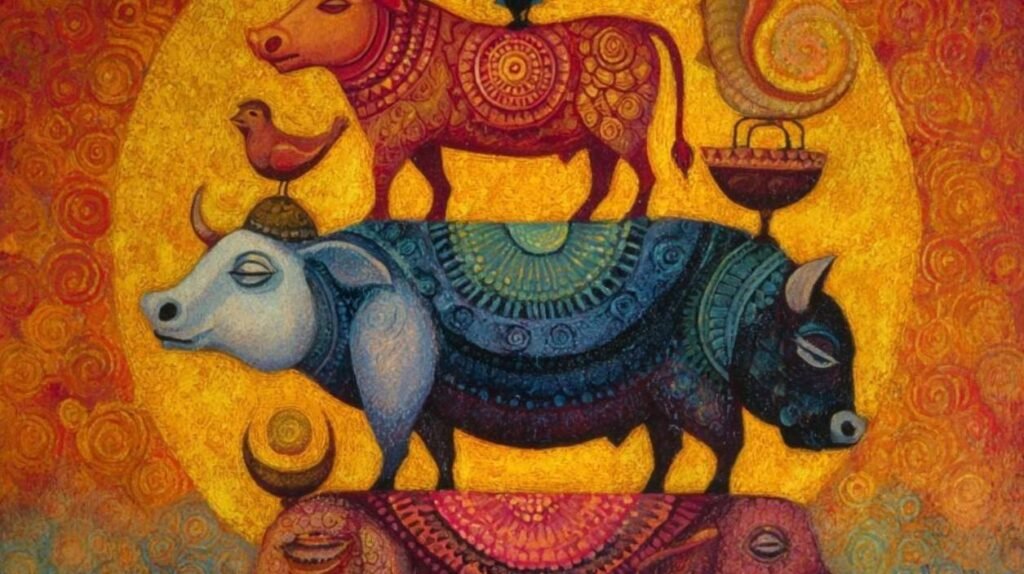
Some years ago, I found myself deeply contemplating a question: what truly defines the happiness of people and societies? Out of this reflection emerged an idea that has stayed with me—the ancient blessings of Dharma, Artha, Kama, and Moksha (the Purusharthas).
These four pillars are not just lofty ideals; I believe they provide a framework that can—and should—reshape how we think about capitalism today. To me, this is the foundation of ethical capitalism: a model of commerce that balances profit with purpose, wealth with wellbeing, and growth with meaning.
The Four Pillars and Their Contemporary Relevance
When I reflect on the Purusharthas, here’s how I see them connecting to our modern pursuit of prosperity:
- Dharma – preserving the evolutionary process. In business, this translates to upholding ethical practices, sustainability, and a duty to all stakeholders, not just shareholders. Are we building, or are we breaking, evolution?
- Artha – wealth, the play of money in capitalism and commerce. Wealth creation is necessary, but when it turns into unchecked profit-seeking, imbalance and bubbles follow. I believe profits beyond a reasonable margin—say, 15-20%—often cross into greed.
- Kama – love, joy, health, and fulfilment. A society or business must nurture not just material needs but also human desires for connection, creativity, and wellbeing.
- Moksha – liberation. To me, this is freedom from the endless cycle of greed and pressure. In a business context, it means fostering meaningful work and a sense of purpose.
Together, these four represent not just personal fulfilment but a collective happiness index—something capitalism has largely lost sight of.
Why Ethical Capitalism Matters Today
When capitalism first took shape, its foundations carried some sense of fairness: the deserving were rewarded, and growth was tied to merit. Over time, that balance eroded. CEOs were trained to maximize shareholder value, and profit became the only metric of success.
The result? A system designed more for speculation than for service. What I call the loss of ethical capitalism.
Ethical capitalism, as I see it, requires a recalibration—bringing Dharma, Artha, Kama, and Moksha back into the equation. Businesses should not only ask, “How much profit did we make?” but also, “How much balance did we create?”
Here’s a way I believe leaders can reinterpret these pillars into business practice:
| Pillar | Modern Business Principle | Takeaway for Leaders |
| Dharma | Duty, ethics, sustainability | Anchor decisions in responsibility, not just quarterly results. |
| Artha | Sustainable, equitable profit | Cap profits reasonably, reinvest in innovation and communities. |
| Kama | Wellbeing and fulfillment | Build cultures that value creativity, joy, and human connection. |
| Moksha | Freedom and purpose | Give employees meaningful work, autonomy, and dignity. |
This isn’t about idealism—it’s about resilience. A business that ignores Dharma collapses under scandal. One that worships Artha without balance bursts in a bubble. One that neglects Kama and Moksha loses its people, its culture, and eventually, its relevance.
A National Happiness Index Rooted in Dharma
At a societal level, I envision a National Happiness Index built not just on GDP or consumption but on the four Purusharthas. Imagine if governments measured:
- Ethical integrity in governance (Dharma)
- Balanced and fair wealth creation (Artha)
- Collective wellbeing and joy (Kama)
- Freedom and fulfillment for citizens (Moksha)
Such an index could reshape policy priorities—from environmental responsibility to mental health, from ethical business incentives to cultural enrichment.
The Bhagavad Gītā reinforces much of this worldview. It speaks of Nishkama Karma—acting with duty, without attachment to results. To me, this is a perfect philosophy for modern leadership: do what is right, not merely what is profitable.
In practice, this means cultivating businesses that are purpose-led, resilient, and human-centered. Profit is not the enemy—but greed, unchecked, certainly is.
To me, ethical capitalism is not a rejection of capitalism—it is capitalism done right. A system that serves rather than exploits, balances rather than inflates, and uplifts rather than consumes. The four Purusharthas remind us that true happiness—whether in a person, a business, or a nation—requires Dharma’s ethical foundation, Artha’s responsible prosperity, Kama’s joy, and Moksha’s liberation.
As leaders and entrepreneurs, our task is to bring these back into the heart of commerce. Only then can capitalism evolve into what it was always meant to be: not a machine for greed, but a vehicle for human flourishing.